
If you’re searching for the best tape measure, you want one thing: a tool that gives you the exact same reading every single time. Not “close enough.” Exact.
A bad tape measure doesn’t just annoy you. It costs you money. A bent hook, a sagging blade, or blurry print can throw off a cut by 1/8 inch — enough to ruin a $40 sheet of plywood or leave a gap behind your new cabinets.
Below, we break down the best tape measures across every common use case. Each pick is judged on accuracy, standout, blade durability, and real-world usability — not just spec-sheet claims.
Quick answer: For most people, a 25-foot tape with a wide blade and a locking hook covers 90% of jobs. If you work solo, get one with a magnetic tip. If you’re a pro on a job site daily, spend the extra money on a heavy-duty model.
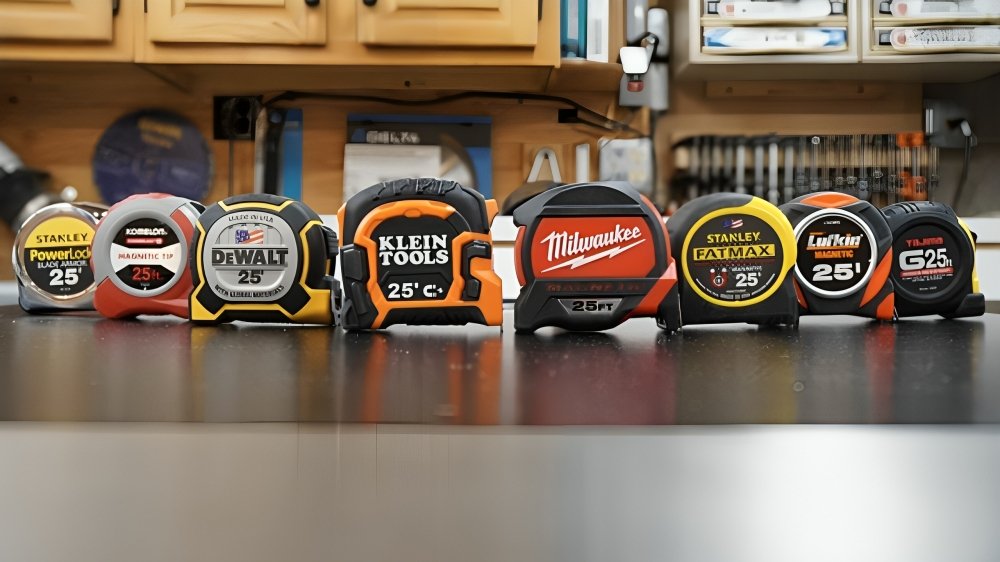
Best Tape Measures at a Glance
| Category | Best Pick | Length | Standout |
|---|---|---|---|
| Best Overall | Stanley FatMax Classic | 25 ft | ~11 ft |
| Best Heavy-Duty | Crescent Lufkin Shockforce Nite Eye G2 | 25 ft | ~12 ft |
| Best Budget | Komelon Self-Lock | 25 ft | ~7 ft |
| Best for Solo Work | Milwaukee Magnetic | 25 ft | ~12 ft |
| Best Compact | Lexivon DuaLock | 16 ft | ~5 ft |
| Best Digital | Prexiso 2-in-1 | N/A | N/A |
| Best Metric/Dual-Scale | Stahlwille 77040010 | 5 m | N/A |
(Insert affiliate pricing table or current price-tracking widget here)
How We Evaluated the Best Tape Measure Options
A tape measure looks simple. It isn’t. Five factors separate a great one from a frustrating one.
Standout
Standout is how far the blade extends before it buckles under its own weight. This matters most when you’re measuring alone, with no wall or surface to brace the blade against.
A tape with 9 feet of standout lets you measure a ceiling or long wall without a helper. A tape with only 4 feet of standout will fold every time you try.
Accuracy and Calibration
Steel tape measures sold in the U.S. are typically built to conform with ASME B89.1.7, a national standard covering graduation spacing, numbering, and permissible error<sup>(Insert ASME B89.1.7 official scope link here)</sup>. In practice, this means a quality 25-foot tape should read within a fraction of an inch of true length across its entire span.
Here’s a tip most buyers don’t know: hook play is a feature, not a defect. The hook is designed to slide slightly — about the thickness of the hook itself — so the tape reads correctly whether you’re pushing it against a surface or hooking it over an edge.
Blade Coating
A tape’s coating determines how long the printed numbers stay legible. Common options:
- Mylar polyester film — budget standard, moderate wear resistance
- Nylon-bond coating — better abrasion resistance, common on mid-range tapes
- Acrylic coating — found on premium tapes, resists rust and fading longest
If you drop your tape on concrete daily, coating quality matters more than almost any other spec.
Hook Design (“True Zero”)
A good hook should rivet — not glue — to the blade. Riveted hooks survive years of slamming against lumber edges.
Look for a hook stamped “Tru-Zero” or similar. This means the hook is calibrated so the zero mark reads correctly whether you’re pushing the tape into a corner or hooking it over an edge.
Locking Mechanism
Most tapes today use a self-locking mechanism — the blade locks automatically as it extends, and a button releases it. This beats older thumb-lock styles for one-handed use.
Best Tape Measure Overall: Stanley FatMax Classic
Why it wins: A 1-1/4 inch wide blade gives roughly 11 feet of standout — enough for most solo ceiling and wall measurements without a second person.
- Length: 25 ft
- Blade coating: BladeArmor protection on the first 6 inches
- Weight: ~14.5 oz
- Best for: General contractors, framers, DIYers doing regular projects
The BladeArmor coating targets the exact spot where tapes fail first — the hook end, where repeated snapping against board edges loosens the rivet over time.
Where it falls short: It’s bulkier than pocket-sized tapes. If you only measure picture frames and small shelves, this is more tool than you need.
Best Heavy-Duty Tape Measure: Crescent Lufkin Shockforce Nite Eye G2
Job site tapes take abuse daily. This one is built for it.
- Length: 25 ft
- Standout: ~12 ft (among the best in class)
- Print style: Reverse-contrast “Nite Eye” markings for low-light readability
- Weight: ~21 oz (heaviest in most comparison tests)
The trade-off for that rigidity is a slightly flattened blade profile. It’s excellent for horizontal standout but can be trickier on vertical measurements without a wall to lean against.
This is the tape to buy if you’re a framer, remodeler, or anyone measuring 50+ times a day.
Best Budget Tape Measure: Komelon Self-Lock
You don’t need to spend $25 to get a reliable tape.
- Price point: Under $10 in most cases
- Length: 25 ft
- Notable feature: Auto-locking blade, smooth retraction
- Standout: ~7 ft
It includes graphic notations at 16-inch and 19.2-inch intervals — the standard stud-spacing marks framers rely on. That’s a feature you’d expect on a $20+ tape, not an $8 one.
Trade-off: Standout is shorter than premium models. Fine for most home tasks; limiting for ceiling work alone.
Best Tape Measure for Solo Work: Milwaukee Magnetic
If you measure alone often, a magnetic hook changes everything.
- Length: 25 ft
- Standout: ~12 ft
- Key feature: Magnetic hook holds to steel studs, brackets, and beams
- Coating: Nylon-bond blade coating
This lets you anchor the hook to a metal surface and pull the tape with one hand — no helper, no awkward bracing against your shoulder.
Best for: Electricians, HVAC techs, and metal-stud framers working without a second set of hands.
Best Compact Tape Measure: Lexivon DuaLock
Not every job needs 25 feet of blade.
- Length: 16 ft
- Why it’s useful: Small enough for a pocket, light enough to forget you’re carrying it
- Dual-locking design: Locks on both push and pull
If most of your measuring involves furniture, picture frames, or small repairs, a bulky 25-ft tape is overkill. This is the better daily-carry option.
Best Digital Tape Measure: Prexiso 2-in-1
Digital tapes solve a specific problem: misreading fine fraction marks.
- Display: Electronic readout, no squinting at 1/16-inch lines
- Memory: Stores multiple measurements
- Unit conversion: Switches between metric and imperial instantly
- Price: Roughly $35, more than standard tapes
Who actually needs this: People with vision difficulty reading fine gradations, or anyone who frequently converts between unit systems mid-project.
Who doesn’t: Most homeowners. It’s a nice-to-have, not a must-have, for basic tasks.
Best Metric Tape Measure: Stahlwille 77040010
For international projects or metric-only plans, a dedicated dual-scale tape avoids confusion.
- Scale: Dual metric/imperial markings
- Build quality: German-engineered components
- Best for: International teams, engineering drawings using millimeters
If your blueprints are in millimeters and your crew thinks in inches, a dual-scale tape removes the need for mental math on-site.
How to Choose the Best Tape Measure for Your Needs
Match the tape to the job, not the other way around.
Length
- 12–16 ft: Furniture, small repairs, picture hanging
- 25 ft: The all-purpose standard for most rooms and framing
- 30–35 ft: Larger rooms, fences, driveway layouts
- 100 ft (open-reel): Site layout, landscaping, surveying
Blade Width
A wider blade (1-1/4 inch) stands out farther before buckling. A narrower blade (3/4 inch) is lighter and easier to carry, but folds sooner.
Units
Choose based on what your plans use:
- Imperial (inches/fractions): Standard for U.S. residential construction
- Metric (mm/cm): Standard for most of the world and many engineering drawings
- Dual-scale: Best if you regularly switch between the two
Standout vs. Weight
This is the core trade-off in every tape measure. More standout generally means a stiffer blade case and more material — which means more weight in your tool belt.
If you carry your tape all day, weight matters. If you mainly use it at a fixed workbench, standout matters more.
Common Tape Measure Mistakes That Wreck Accuracy
Most measuring errors aren’t the tape’s fault. They’re technique errors.
- Ignoring hook play. Don’t force the hook flush — it’s designed to float slightly for accuracy.
- Not “burning an inch.” On a damaged hook, measure from the 1-inch mark instead of zero, then subtract 1 inch from your reading.
- Letting the blade sag on long spans. An unsupported blade over 6+ feet will bow, adding tiny errors. Support it midway when possible.
- Reading the wrong fraction line. On a busy blade, it’s easy to misread 1/16 for 1/8. Slow down on critical cuts.
- Using a worn-out tape for fine work. If the hook rivet is loose or the case has been crushed, retire it for precision tasks — keep it for rough estimates only.
How to Read a Tape Measure (Fast Reference)
- Each inch is divided into smaller fractions: halves, quarters, eighths, sixteenths.
- The longer lines mark whole inches; the tallest mark every foot.
- Black diamonds (on many tapes) mark 19.2-inch intervals — five equal floor-joist spacings per 8-foot sheet.
- Red numbers typically mark 16-inch intervals — standard stud spacing in U.S. framing.
Tape Measure Maintenance: Making It Last
A few habits add years to any tape measure’s working life.
- Wipe the blade after outdoor or dusty use — grit accelerates print wear.
- Avoid letting the blade snap back hard repeatedly; ease it in when possible.
- Store it dry. Moisture trapped in the case can rust the spring and blade.
- Check the hook rivet periodically. A loose hook is the most common cause of inaccurate readings.
Frequently Asked Questions
Accuracy is less about brand and more about condition. A new, undamaged steel tape from any reputable manufacturer will meet ASME B89.1.7 tolerances<sup>(Insert specific tolerance figure/source here)</sup>. The bigger accuracy risk is a bent hook or stretched blade from wear, not the manufacturer’s specs.
For standout and rigidity, yes. A 1-1/4 inch blade resists buckling far better than a 3/4 inch blade. For portability and pocket carry, a narrower blade wins instead.
Match your plans. U.S. residential construction is almost universally imperial. If you work on international projects or engineering specs, get a dual-scale or metric tape to avoid conversion errors.
There’s no fixed timeline — it depends on use. Replace it when the hook rivet loosens, the case cracks, or the print fades enough to misread numbers. For daily job-site use, that might be every 1–2 years. For occasional home use, a quality tape can last a decade or more.
Final Verdict
For most people, the Stanley FatMax Classic is the best tape measure — wide blade, strong standout, and a hook coating that solves the most common failure point.
If you’re on a job site daily, the Crescent Lufkin Shockforce Nite Eye G2 justifies its extra weight with superior durability. On a budget, the Komelon Self-Lock delivers professional-grade stud markings for under $10.
Whichever you choose, remember: the best tape measure is the one whose hook hasn’t been bent. Check it before every critical cut.
Read More Blogs: Best Ryobi Drill in 2026: Honest Picks for Every Budget & Project