
If you’re searching for the best commercial pressure washer, you’re not shopping the same market as a homeowner. You need a machine built to run for hours, survive daily transport, and generate ROI — not just blast a driveway on weekends.
This guide cuts through the noise. It’s built for contractors, business owners, and facility managers who need the right unit the first time.
What Actually Separates a Commercial Pressure Washer from a Consumer Model?
Most people compare PSI ratings and stop there. That’s a mistake.
True commercial pressure washers differ from consumer units in three fundamental ways:
- Pump quality: Commercial machines use triplex plunger pumps. Consumer units use wobble or axial pumps, which fail under sustained use.
- Duty cycle: Commercial units are rated for continuous operation — often 8+ hours per day. Consumer units are not.
- Component serviceability: You can rebuild a commercial pump. Most consumer pumps are throw-away.
A $500 big-box pressure washer running daily will cost more in replacements over 12 months than a $1,800 commercial unit running the same schedule.
PSI vs. GPM — Which Number Really Matters?
PSI (Pounds per Square Inch) measures pressure intensity. GPM (Gallons per Minute) measures water volume and flow.
The real metric is Cleaning Units (CU):
CU = PSI × GPM
| PSI | GPM | Cleaning Units | Best For |
|---|---|---|---|
| 2,000 | 2.0 | 4,000 CU | Light residential |
| 3,500 | 2.4 | 8,400 CU | Light commercial |
| 4,000 | 4.0 | 16,000 CU | Heavy commercial |
| 3,500 | 5.5 | 19,250 CU | High-volume commercial |
Key insight: A machine with 3,500 PSI and 5.5 GPM outperforms a 4,200 PSI / 2.5 GPM unit on almost every real-world commercial job. GPM is often more important than PSI for efficiency.
[(Insert industry source: Power Washers of North America (PWNA) or equivalent)]
Hot Water vs. Cold Water Units
Cold water units handle the majority of commercial cleaning jobs. They’re the go-to for:
- Surface cleaning (concrete, asphalt, brick)
- Building exterior washing
- Fleet washing (non-grease)
Hot water units are essential for:
- Grease and oil removal
- Food service equipment
- Engine degreasing
- Sanitization applications
Hot water can reduce cleaning time by up to 40% on grease-heavy surfaces, according to industry data. [(Insert source)] The trade-off is higher upfront cost — typically $3,000–$10,000+ more than comparable cold water models.
Duty Cycle: The Spec Nobody Talks About
Duty cycle is the percentage of time a machine can run without overheating or damage.
- Consumer units: 20–40% duty cycle (run 10 minutes, rest 20)
- Commercial units: 80–100% duty cycle (run continuously for hours)
Always ask for the duty cycle specification before buying. If a vendor can’t answer, walk away.
Belt Drive vs. Direct Drive — The Decision That Defines Your Machine’s Lifespan
This is the most important technical decision in commercial pressure washer buying. Most buyers get it wrong.
Direct Drive: Best For…
In a direct drive system, the pump connects directly to the engine crankshaft. The pump spins at engine RPM — typically 3,400–3,600 RPM.
Advantages:
- Lower upfront cost
- More compact and lightweight
- Easier to maneuver on job sites
Disadvantages:
- Higher pump RPM = more heat and faster wear
- Shorter pump lifespan under heavy commercial use
- Not ideal for extended daily operation
Best for: Contractors doing residential work, intermittent commercial jobs, or operations where portability is the top priority.
Belt Drive: Best For…
Belt drive units use a pulley system to transfer power. The pump typically runs at 1,200–1,450 RPM — roughly half the speed of a direct drive system.
Advantages:
- Dramatically cooler pump operation
- Significantly longer pump lifespan (up to 2–3x a comparable direct drive unit)
- Belt acts as a mechanical safety — absorbs shock before it destroys the pump
- Better for buffer tank operation (pulling from a tank, not direct supply)
Disadvantages:
- Heavier and bulkier
- Higher initial cost ($300–$700 more typically)
- Belt requires periodic inspection and replacement
Best for: Professional contractors running full days, fleet washing operations, truck-mount setups, and any business where the machine is the primary revenue-generating tool.
The bottom line: If you’re running 4+ hours per day on commercial jobs, belt drive pays for itself in pump replacements avoided within the first year.
Gear Drive: The Middle Ground
Gear drive machines use interlocking gears instead of a belt. They run cooler than direct drive but warmer than belt drive.
They’re a reasonable compromise when budget and footprint matter, but for true heavy commercial use, belt drive remains the industry standard.
Best Commercial Pressure Washers in 2025 — Top Picks by Category
These picks are based on industry reputation, verified user feedback, component quality, and real-world commercial use data. No sponsored placements.
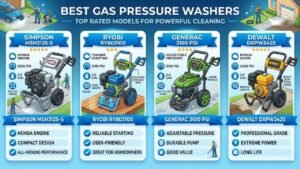
Best Overall: Simpson Aluminum Series (4,000 PSI / 4.0 GPM)
Why it wins: The Simpson Aluminum Series is one of the most widely used commercial gas pressure washers among professional contractors. The aircraft-grade aluminum frame keeps weight manageable without sacrificing structural integrity.
Standout specs:
- Engine: Honda GX390 (or Kohler CH440) — both are industry-proven
- Pump: AAA professional triplex pump
- Hose: 50-foot, 4,000 PSI-rated hose included
- Drive: Direct drive (note: consider this for your duty cycle needs)
Best for: Contractors needing a reliable, portable gas unit for residential and light commercial jobs.
Watch out for: Not ideal for 8-hour-a-day heavy commercial operation due to direct drive pump RPM.
[(Insert current pricing / retailer link)]
Best Budget Commercial Option: Kärcher Pro Am HD (3,500 PSI / 2.4 GPM)
Why it wins: The Kärcher Pro Am HD is the entry point for legitimate commercial equipment. It uses a fully serviceable pump — a critical differentiator from big-box alternatives.
Standout specs:
- Fully serviceable pump (not a throw-away design)
- Removable detergent tank for easy cleaning and maintenance
- 35-foot high-pressure hose
- Kärcher KXS gas engine with pull start
Best for: Small businesses, occasional commercial use, and operators upgrading from a consumer unit for the first time.
Watch out for: 2.4 GPM is the lowest flow rate in this category. For large surface areas, job times will be longer than higher-GPM alternatives.
[(Insert current pricing / retailer link)]
Best Hot Water Unit: Landa HD Series (3,500 PSI / 4.0 GPM+)
Why it wins: The Landa HD is one of the most trusted names in commercial hot water pressure washing. Available in both direct drive and belt drive configurations, it lets you choose based on your operation’s intensity.
Standout specs:
- Highest PSI and GPM combination in its class
- Belt drive option eliminates vibration and heat transfer to the pump
- Built for medium-to-heavy commercial use
- Detergent injection system included
Best for: Restaurants, food processing facilities, fleet managers dealing with grease and oil, and industrial cleaning contractors.
Watch out for: Premium pricing. This is a professional-grade investment, not a budget purchase.
[(Insert current pricing / authorized dealer link)]
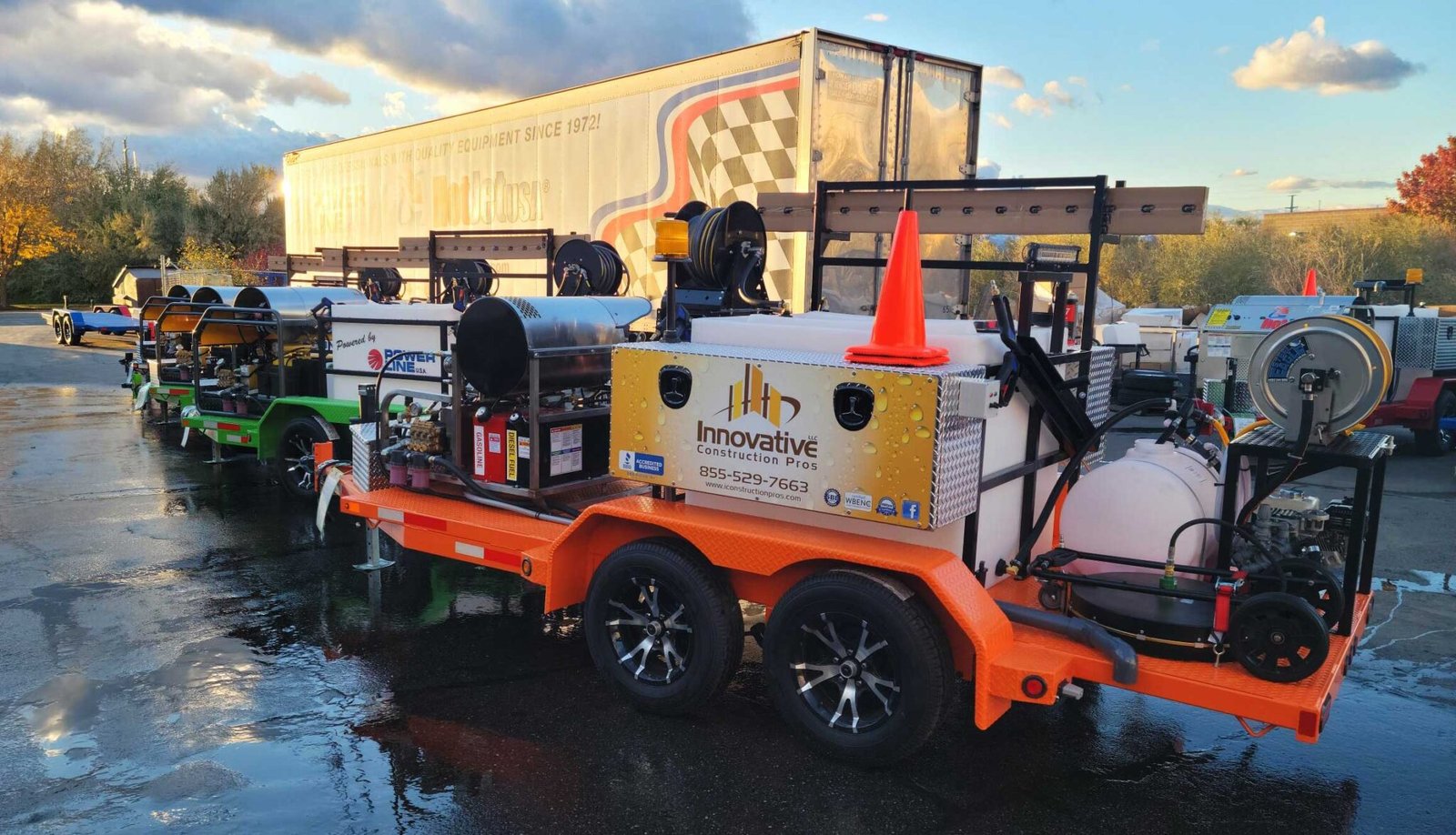
Best for Mobile/Truck-Mount Operations: Easy-Kleen EZO3504G
Why it wins: If your business goes to the job site — construction yards, logging operations, fleet maintenance — you need a truck-mount unit. The Easy-Kleen EZO3504G is engineered specifically for this use case.
Standout specs:
- Designed for pickup truck bed mounting
- Durable frame built for transport vibration
- Includes everything needed for mobile setup
Best for: Mobile pressure washing businesses, equipment rental companies, and contractors cleaning off-site machinery.
[(Insert current pricing / retailer link)]
Best Electric Commercial Unit: Mi-T-M 1,500 PSI Electric
Why it wins: Gas is not always an option. Indoor cleaning, food service environments, and noise-restricted locations require electric units. The Mi-T-M 1500 PSI uses an aluminum frame for portability and corrosion resistance.
Standout specs:
- Zero emissions — safe for indoor and enclosed spaces
- Quiet operation — suitable for noise-sensitive environments
- Aluminum frame: lightweight and rust-resistant
- Consistent pressure without engine warm-up
Best for: Restaurant kitchens, indoor facilities, hospital maintenance, and any environment where gas engines are prohibited.
Watch out for: 1,500 PSI limits heavy-duty outdoor cleaning. This unit is purpose-built for specific indoor commercial applications.
[(Insert current pricing / retailer link)]
How to Match a Pressure Washer to Your Specific Business Type
Don’t buy by spec sheet alone. Match the machine to your actual operation.
Pressure Washing Contractors (Residential & Commercial)
What you need:
- Minimum 4.0 GPM for surface cleaning efficiency
- Belt drive if running 6+ hours daily
- 50-foot hose minimum for reaching second stories
- Cold water is sufficient for most jobs; hot water for roof and organic stain work
Recommended range: 3,500–4,000 PSI / 4.0–5.5 GPM belt drive gas unit
Fleet & Vehicle Cleaning
What you need:
- Minimum 3.5 GPM
- Hot water capability if cleaning engines or undercarriages
- Foam cannon compatibility for detergent application
- Trailer or truck-mount setup for multiple vehicle locations
Recommended range: 3,000–3,500 PSI / 3.5–5.0 GPM, hot water preferred
Food Service & Restaurant Cleaning
What you need:
- Hot water unit (essential for grease and sanitation)
- Electric-compatible if cleaning indoors
- Detergent injection system
- Low-noise operation for proximity to occupied spaces
Recommended range: Electric or propane hot water unit, 1,500–3,000 PSI
Construction & Industrial Sites
What you need:
- Maximum cleaning units — prioritize GPM over PSI
- Rugged frame rated for job site transport
- Truck or trailer mount for site mobility
- Diesel or propane power for remote locations without electricity
Recommended range: 4,000+ PSI / 5.0+ GPM, belt drive, with hot water option
Red Flags to Avoid When Buying a Commercial Pressure Washer
These are the mistakes that cost contractors thousands in repairs or replacements:
- Wobble or axial pumps masquerading as “commercial.” If the pump isn’t a triplex plunger design, it isn’t truly commercial grade.
- No duty cycle specification. Any legitimate commercial unit will have one. If the spec sheet doesn’t list it, the machine likely isn’t rated for sustained use.
- Consumer engines on “commercial” frames. Briggs & Stratton 550E series and similar engines are not commercial grade. Look for Honda GX series, Kohler Command, Kawasaki FX, or Vanguard engines.
- Cheap plastic fittings and connectors. Commercial hoses, guns, and wands should be rated to match the machine’s PSI. Inspect fitting materials before purchase.
- No local service support. Buying a commercial unit from a brand with no authorized service network nearby is a risk. Downtime is revenue loss.
- Chasing maximum PSI over GPM. As established earlier, more GPM usually wins on real job efficiency. Don’t pay a premium for 4,200 PSI if it comes with 2.0 GPM.
Commercial Pressure Washer Maintenance — Keeping Your Investment Alive
A commercial pressure washer maintained properly can run for 10–15+ years. Neglected units fail within 2–3.
After every use:
- Flush the pump with fresh water to remove detergent residue
- Release pressure from the hose and gun before disconnecting
- Inspect hose for kinks, cracks, or abrasion damage
Monthly (or every 50 hours of use):
- Check and change pump oil (most commercial triplex pumps require 30W non-detergent oil)
- Inspect nozzles for wear or clogging
- Test unloader valve operation
- Check belt tension and condition (belt drive units)
Annually (or every 200 hours):
- Full pump oil change
- Inspect all seals and O-rings
- Test pressure output against rated PSI
- Service the engine per manufacturer schedule (oil, air filter, spark plugs)
Winterization (cold climates):
- Run pump antifreeze through the system before storage
- Store in a temperature-controlled environment if possible
- Never leave water standing in the pump in freezing conditions — this is the single most common cause of avoidable pump failure
[(Insert pump antifreeze product recommendation or source)]
Frequently Asked Questions
There’s no universal standard, but most industry professionals consider 3,000+ PSI with a triplex pump and 100% duty cycle to be the minimum threshold for true commercial use.
Yes. Commercial units are versatile. The key is using appropriate nozzles and pressure for the surface — a 4,000 PSI machine won’t damage a deck if you use the correct nozzle angle and distance.
With proper maintenance, a belt drive commercial unit with a quality triplex pump should last 10–20 years. Direct drive units under heavy commercial use typically see pump replacement every 3–5 years.
It depends entirely on your use case. Gas offers mobility and higher output. Electric offers silence, zero emissions, and no fuel costs — essential for indoor applications. For most outdoor commercial work, gas remains the dominant choice.
Commercial units typically operate in the 3,000–5,000 PSI range and handle daily professional cleaning tasks. Industrial units often exceed 5,000 PSI and are designed for applications like paint stripping, surface preparation, and manufacturing facility cleaning.
Only if your work involves grease, oil, biological matter, or sanitization requirements. Cold water handles the vast majority of commercial cleaning tasks perfectly well.
Final Verdict: How to Choose the Right Commercial Pressure Washer
Here’s the decision framework in plain terms:
| If you… | Choose… |
|---|---|
| Run 6+ hours/day on commercial contracts | Belt drive, 4.0+ GPM gas unit |
| Do occasional commercial jobs, mostly residential | Direct drive, 3,500 PSI, Honda engine |
| Clean grease, oil, or food service equipment | Hot water unit, 3,000+ PSI |
| Need indoor or noise-restricted use | Electric commercial unit |
| Run a mobile operation from a truck | Truck-mount belt drive unit |
The single best-value commercial pressure washer for most contractors in 2025 is a belt drive gas unit in the 3,500–4,000 PSI / 4.0–5.5 GPM range, powered by a Honda GX or Kohler Command engine, with a AAA or AR triplex pump. That combination covers 80%+ of professional commercial applications and will last for years with basic maintenance.
Don’t buy once and pay twice. Buy the right commercial pressure washer now.
Read Related Blogs: