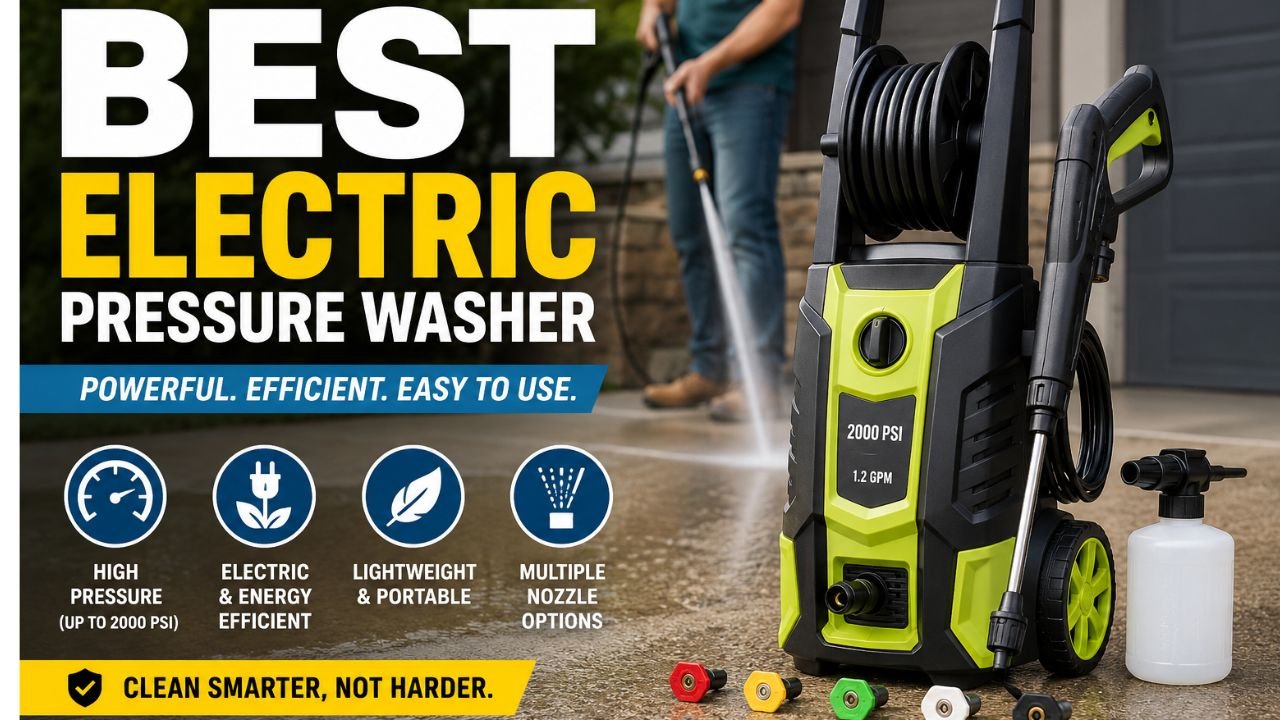

Last spring, after staring at my moss-covered driveway for long enough, I finally decided to stop borrowing my neighbour’s loud, leaky gas pressure washer and find something I could actually own and enjoy using. What followed was several weeks of testing corded, cordless, and hybrid electric models back-to-back on concrete, timber decking, a truck, and a stretch of render that had turned a deeply unappealing shade of green. The market has genuinely moved on — today’s best electric pressure washers have come a long way, and some now have the power to legitimately compete with gas.
If you’ve been asking yourself what is the best electric pressure washer for home use, this guide gives you a straight answer built on real testing, not spec sheet comparisons. I’ll walk you through my top picks, the specs that actually matter, and the mistakes I made along the way so you don’t have to repeat them.
Quick answer: The DeWalt DWPW2600 is the best corded pick for most homeowners. For cordless freedom with serious power, the EGO HPW3200 leads the field. On a tighter budget, the Ryobi RY142012 punches well above its price.
What makes a great electric pressure washer in 2026?
Before I get into the individual reviews, it’s worth understanding the criteria I used to evaluate these machines — because marketing specs can be genuinely misleading. One of the first things I learned is to look for PWMA or CETA certification when comparing models. Some brands market “PSI Max*” figures measured inside the machine, not at the nozzle, which inflates their numbers considerably. Certified performance figures give you an honest comparison. DeWalt, for example, uses “PSI Max” to refer specifically to the maximum pressure at the nozzle using a 15° nozzle — and is CETA-certified — which is very different from how some other brands use the same term.
Beyond certification, I evaluated each machine on motor type (brushless motors consistently outperformed brushed ones for power and longevity), pump type (triplex pumps are built for professional hours; axial cam pumps are perfectly adequate for homeowners), hose length, wheel practicality on grass and gravel, and how well accessories stored on-board. Cleaning power, expressed as PSI multiplied by GPM, was my headline performance metric — a machine with 2,000 PSI and 1.2 GPM delivers 2,400 cleaning units, while one with 2,200 PSI and 1.2 GPM delivers 2,640.
Top picks at a glance
| Model | PSI | GPM | Motor | Certified | Price | Best for |
| DeWalt DWPW2600 | 2,600 | 1.1 | 13A brushed | CETA | ~$399 | Best corded |
| EGO HPW3200 | 3,200 | 1.2 | 56V brushless | — | $499–$779 | Best cordless |
| Greenworks PW3000HYB | 3,000 | 1.1 | 60V brushless | PWMA | ~$679 | Best hybrid |
| Ryobi RY142012 | 2,100 | 1.2 | 13A brushed | PWMA | ~$199 | Best budget |
| Sun Joe SPX3000 XTREAM | 2,200 | 1.1 | 14.9A brushed | PWMA | ~$239 | Mid-range value |
| Greenworks GPW2500C | 2,500 | 1.2 | 14A brushless | PWMA | ~$699 | Pro/commercial |
In-depth reviews: best electric pressure washer picks
DeWalt DWPW2600 — Best corded electric pressure washer
- Top corded pick
- 4.8 / 5
| Specification | Details |
|---|---|
| PSI | 2,600 |
| GPM | 1.1 |
| Motor | 13A |
| Pump | Axial Cam |
| Certified | CETA |
| Warranty | 3 Years |
DeWalt shook things up with this compact roll cage frame design, and after spending real time with it, I understand why it stood out. The DWPW2600 sits in a sweet spot between DeWalt’s 2,100 PSI and 3,000 PSI models — noticeably more powerful than the entry-level option but still manageable in terms of size and weight. I paired it with a 13-inch surface cleaner across two sessions of concrete work and the results were impressively fast and even.
What genuinely impressed me was the storage system. Every accessory — hose, nozzles, foam cannon — tucks neatly inside or onto the unit itself. The cord wraps on the back, the hose sits in the front cage, and the nozzles clip on the wand. It is the best-organised pressure washer I have used. One limitation worth noting: the small wheels struggle on bare ground and thick grass, so if you need to wheel it across a lawn regularly, be prepared to carry it instead.
The built-in inline GFCI protection and CETA-certified performance figures give it added credibility — you know exactly what you are getting before you buy.
Best for: Homeowners who want CETA-certified performance, excellent storage, and a compact form factor. Not ideal if your property requires a lot of grass traversal.
EGO HPW3200 — Best cordless electric pressure washer
- Best cordless
- 4.7 / 5
| Specification | Details |
|---|---|
| PSI | 3,200 |
| GPM | 1.2 |
| Motor | 56V Brushless |
| Pump | Axial Cam |
| Certified | Pending |
| Warranty | 5 Years |
If you want the highest performance available in a battery-powered electric pressure washer, the EGO HPW3200 is genuinely in its own class. At 3,200 PSI and 1.2 GPM it outperforms every 120V corded model I tested, and the freedom from a cord and a fixed water outlet makes it far more versatile around the property. I used it to clean the back fence — nowhere near a power outlet — with nothing but a bucket of water via the siphon hose, which is a capability most people don’t realise they need until they have it.
Runtime management is the key skill to develop with this machine. There are three power modes adjustable right on the wand: ECO gives around an hour of run time on two 6.0Ah batteries, while High and Turbo are where you will do most of your serious cleaning. The Turbo nozzle is the standout — run most jobs in High mode to conserve battery, then switch to Turbo only when you hit stubborn build-up. For a standard four-car driveway, even with 12Ah batteries, runtime is a genuine constraint, so a corded model remains the more efficient choice for large concrete jobs.
EGO’s five-year warranty is the longest in the category, and while independent certification is still pending, EGO has a strong track record of delivering on or exceeding their stated figures.
Best for: Users who prioritise cordless freedom and maximum performance. Budget accordingly — the kit price starts at $779, and higher-capacity batteries improve the experience significantly.
Greenworks PW3000HYB — Best hybrid electric pressure washer
- Best hybrid
- 4.7 / 5
| Specification | Details |
|---|---|
| PSI | 3,000 |
| GPM | 1.1 |
| Motor | 60V Brushless |
| Pump | Axial Cam |
| Certified | PWMA |
| Warranty | 4 Years + 10 Years Motor |
The Greenworks hybrid is the most versatile machine in this roundup. It runs on either 60V batteries or standard 120V AC power — you choose based on the job. For large concrete work I plugged it in for unlimited runtime at the full 3,000 PSI. For quick tasks like cleaning the grill, washing the truck, or reaching the soffit, I ran it on battery and enjoyed the freedom of no cord dragging behind me. It is a genuine best-of-both-worlds design, and the TrueBrushless motor intelligently adapts output based on the nozzle attached, which is a thoughtful feature I noticed most when switching between the turbo and soap nozzles mid-job.
The all-terrain wheels are a meaningful upgrade over most of the competition — they rolled easily over my patchy, uneven lawn without any of the tipping issues I experienced with smaller-wheeled machines. PWMA certification and a ten-year motor warranty add long-term confidence, though at $679 it is a serious investment.
Best for: Homeowners who want maximum flexibility across different job types. The premium price is justified if you will genuinely use both power modes.
Ryobi RY142012 — Best budget electric pressure washer
- Budget pick
- 4.3 / 5
| Specification | Details |
|---|---|
| PSI | 2,100 |
| GPM | 1.2 |
| Motor | 13A |
| Pump | Axial Cam |
| Certified | PWMA |
| Warranty | 3 Years |
Launched in late 2025, the RY142012 takes Ryobi’s reliable 2,100 PSI performance platform and packages it in a noticeably slimmer, lighter body than previous generations. At around 27 pounds it is genuinely easy to carry between testing spots, which I appreciated across a full day of use. Pairing it with Ryobi’s 12-inch surface cleaner made the concrete section surprisingly fast, and the turbo nozzle handles fencing and siding confidently for a machine at this price point.
The only real limitation is nozzle variety — this model ships with only a 15° tip and a turbo nozzle. For most home tasks that is sufficient, but if you regularly clean vehicles or delicate surfaces and want a 25° or 40° option included in the box, you will need to buy those separately. The small wheels are also worth noting — rolling across thick grass took more effort than expected. That said, at $199 with PWMA-certified performance, it is the best electric pressure washer for buyers who want honest, reliable power without overspending.
Best for: Budget-conscious homeowners with driveways, paths, and garden furniture to maintain. A solid first pressure washer that will not disappoint.
Sun Joe SPX3000 XTREAM — Best mid-range value
- Mid-range
- 4.2 / 5
| Specification | Details |
|---|---|
| PSI | 2,200 |
| GPM | 1.1 |
| Motor | 14.9A |
| Pump | Axial Cam |
| Certified | PWMA |
| Warranty | 3 Years |
Sun Joe’s move to PWMA-rated performance figures makes comparing the SPX3000 XTREAM to the rest of the field much more straightforward than it used to be. At 2,200 PSI it sits a step above the 2,100 PSI class and I noticed the difference when running a surface cleaner — it felt more confident and consistent across a large stretch of concrete. The tall, narrow form factor also means it takes up less floor space than you might expect given its height, which is a genuine advantage for compact storage.
The one frustration I encountered repeatedly was the 20-foot hose — five feet shorter than most competitors. When cleaning around a truck I had to reposition the unit more often than I would have liked. It is not a deal-breaker, but it is worth knowing before you buy. The turbo nozzle is also sold separately, which feels like an oversight at $239.
Best for: Users who need a compact, PWMA-certified machine with a slightly higher PSI than the budget class. Buy an extension hose if you plan to clean large areas.
Corded vs cordless vs hybrid — which type is right for you?
| Feature | Corded | Cordless | Hybrid |
| Runtime | Unlimited | Limited by battery | Unlimited (corded) or battery |
| Max PSI available | Up to 3,000 | Up to 3,200 | Up to 3,000 |
| Needs power outlet | Yes | No | Optional |
| Can use siphon hose | Rarely | Often | Often |
| Maintenance level | Low | Low | Low |
| Entry price | $130–$400 | $499+ | $679+ |
| Best suited for | Driveways, patios, regular use | Vehicles, off-grid, versatile use | All-round heavy use |
Buying guide: what to look for in the best electric pressure washer
The single most important advice I can give you before buying is to check for PWMA or CETA certification. These independent organisations set testing standards that prevent brands from publishing inflated PSI and GPM figures. A certified machine at 2,100 PSI will clean more effectively than an uncertified machine claiming 2,500 PSI, and you will only discover that difference after you have already bought it. Most of the top picks in this guide carry certification — it is the first filter I would apply to any shortlist.
On motor type, brushless motors are clearly superior for performance, longevity, and runtime in cordless models. If you are spending $300 or more, there is little reason to accept a brushed motor. In the budget category, brushed motors are perfectly adequate for homeowner use and offer years of reliable service — just do not expect the same sustained performance under extended load. Pump type matters less at the homeowner level: axial cam pumps serve most people well for many years. Triplex pumps are built for professional hours and typically come on commercial-grade machines at significantly higher prices.
Wheels deserve more attention than most shoppers give them. Large-diameter or wide wheels handle grass and uneven ground far better than the small plastic ones that come on budget machines. If you cannot roll it easily, you will end up carrying it — and a 27-pound machine becomes heavy very quickly across a full cleaning session. Finally, always multiply PSI by GPM to compare cleaning power honestly: a machine with 2,200 PSI at 1.1 GPM delivers 2,420 cleaning units, while one with 2,100 PSI at 1.2 GPM delivers 2,520 — the lower-headline machine is actually more effective.
Mistakes I made so you don’t have to
The most costly error I made early in testing was reaching for the turbo nozzle by default on every surface. Turbo nozzles rotate the jet in a tight circle and are excellent for concrete and block paving — but on timber decking, that same force left visible streaking and raised the grain noticeably. On wood always start with a 40° tip and only increase pressure if it is clearly insufficient. The same logic applies to vehicle paintwork: 25° minimum, at least 30 centimetres of standoff distance, and never linger on the same spot.
Frequently asked questions
Q1. What is the best electric pressure washer for home use in 2026?
Based on my hands-on testing, the Sun Joe SPX3000 is the best electric pressure washer for the majority of homeowners. It balances pressure, flow rate, nozzle variety, and price better than any other machine at its price point. If budget allows, the Kärcher K5 Premium is the superior machine overall.
Q2. How many PSI do I need for a driveway?
For a standard concrete driveway with moss or general grime, 1,800–2,000 PSI is entirely sufficient. You only need to go higher if you are dealing with deeply ingrained staining or rough aggregate surfaces. Higher PSI can damage softer materials, so match the pressure to the surface.
Q3. Are electric pressure washers as good as gas?
For typical home use, yes. Electric machines now reach PSI levels that handle almost every domestic task with ease. Gas pressure washers still have an edge in sustained power for professional or agricultural use, but the maintenance burden, noise, and weight of gas machines make electric the better practical choice for most homeowners.
Q4. How long do electric pressure washers last?
A well-maintained electric pressure washer from a reputable brand should last between 4 and 10 years depending on frequency of use and build quality. The key maintenance steps are flushing the pump with clean water after every use, storing it frost-free in winter, and replacing O-rings at the first sign of leakage.
Read More Blogs: Best Cordless Drills (2026 Guide): Top Picks, Features, and Buying Tips