
If you’re searching for the best gas pressure washer, you already know electric models won’t cut it. You need serious PSI for driveways, siding, decks, and deep-cleaning jobs that leave electric washers wheezing. This guide cuts through the noise — no filler, no vague recommendations — just tested picks, hard specs, and a buying framework that helps you spend smart.
Why a Gas Pressure Washer Outperforms Electric
Before the list, let’s settle one thing: gas isn’t always better. But for the jobs that matter most, it dominates.
Power Output: PSI & GPM Side by Side
| Metric | Gas Pressure Washer | Electric Pressure Washer |
| PSI Range | 2,500 – 4,400 | 1,300 – 2,300 |
| GPM Range | 2.0 – 4.0 | 1.0 – 1.8 |
| Cleaning Units (CU) | 6,000 – 15,000+ | 1,500 – 4,000 |
Cleaning Units = PSI × GPM. This is the real measure of a pressure washer’s power. Don’t shop by PSI alone.
Portability & Cord-Free Freedom
- No outlet needed. Work on driveways, farms, job sites, or anywhere off-grid.
- Longer runtimes. A full tank runs 1–2 hours continuously.
- Higher water flow. Gas pumps move more GPM, which means faster rinsing.
When Electric Is Actually the Better Choice
Be honest with yourself. Choose electric if you:
- Only wash cars or light patio furniture
- Live in an apartment or have no storage for gas equipment
- Hate maintenance and want a grab-and-go machine
- Prioritize ultra-low noise levels
How We Evaluated These Machines
Our selection criteria weren’t based on spec sheets alone. We reviewed hands-on testing data, owner feedback across thousands of reviews, engine reliability records, and long-term durability reports. [(Insert source: Consumer Reports / PTEN testing data)]
What we graded each machine on:
- Engine brand & reliability (Honda, Briggs & Stratton, Subaru = gold standard)
- Pump type (triplex > axial for longevity)
- Cleaning units (PSI × GPM combined score)
- Frame quality & wheel design
- Ease of assembly & startup
- Warranty coverage
- Real-world owner satisfaction across verified purchase reviews
Best Gas Pressure Washers — Our Top Picks for 2025
Quick Comparison Table
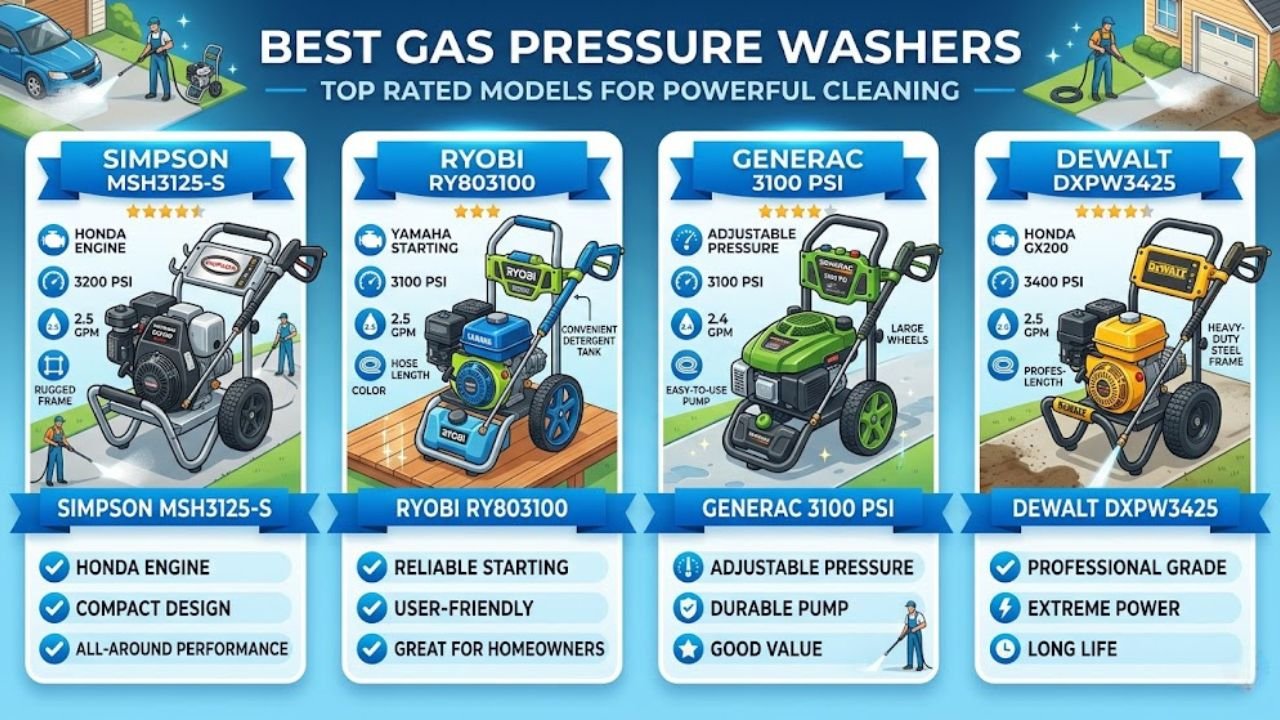
| Rank | Model | PSI | GPM | Engine | Best For |
| 1 | Simpson MSH3125-S | 3,200 | 2.5 | Honda GC190 | Overall Best |
| 2 | Westinghouse WPX3200 | 3,200 | 2.5 | Westinghouse | Best Value |
| 3 | Simpson MegaShot MS60763 | 3,200 | 2.8 | Honda GC190 | Heavy-Duty |
| 4 | Generac 7019 SpeedWash | 3,100 | 2.4 | Generac OHV | Speed & Ease |
| 5 | Ryobi RY803001 | 3,000 | 1.1 | Ryobi OHV | Home Use |
| 6 | Briggs & Stratton 20680 | 3,200 | 2.8 | B&S 190cc | Contractor |
| 7 | Sun Joe SPX9006-PRO | 2,800 | 1.3 | Briggs 875exi | Light Residential |
1. Simpson MSH3125-S — Best Overall Gas Pressure Washer
Key Specs:
- PSI: 3,200
- GPM: 2.5
- Cleaning Units: 8,000
- Engine: Honda GC190
- Pump: AAA Industrial Triplex
- Weight: 73 lbs
- Warranty: 5 years (frame), 2 years (pump), 3 years (engine)
The Simpson MSH3125-S is the gold standard for a reason. The Honda GC190 engine is one of the most reliable small engines ever built. Pair it with an AAA triplex pump — which outlasts axial pumps by 3–5x in duty cycles — and you have a machine built to run for years. [(Insert source: Simpson Cleaning brand data / Honda engine reliability reports)]
What stands out in real use:
- Starts on the first or second pull, even in winter storage
- The 25-foot hose is kink-resistant and long enough for most driveways
- Low-vibration handle reduces fatigue during long sessions
- Maintains consistent pressure from start to finish
Pros:
- Industry-leading Honda engine
- Triplex pump dramatically extends machine life
- Five nozzles included (0°, 15°, 25°, 40°, soap)
- Heavy-duty steel frame with never-flat tires
Cons:
- Premium price (~$399–$449 USD)
- Heavier than budget alternatives
- No built-in detergent tank
Who It’s Best For: Anyone who wants a machine that lasts 10+ years without major repairs. Ideal for homeowners with large driveways, two-story siding, or frequent cleaning needs.
2. Westinghouse WPX3200 — Best Value Gas Pressure Washer
Key Specs:
- PSI: 3,200
- GPM: 2.5
- Cleaning Units: 8,000
- Engine: Westinghouse 212cc OHV
- Pump: Axial cam
- Weight: 68 lbs
- Warranty: 3 years
The Westinghouse WPX3200 punches well above its price. At roughly $280–$320 USD, it delivers Honda-class PSI at a significant discount. The Westinghouse 212cc OHV engine is surprisingly robust for its price tier. [(Insert source: verified purchase reviews / Amazon ratings)]
Pros:
- Outstanding price-to-performance ratio
- Includes a 5-in-1 adjustable nozzle plus a turbo nozzle
- Onboard detergent tank (0.5L)
- Easy-fold handle for compact storage
Cons:
- Axial pump less durable than triplex under daily heavy use
- Westinghouse engine doesn’t match Honda’s long-term track record
- Hose quality could be improved
Who It’s Best For: Homeowners who want professional-level cleaning power without the professional price tag.
3. Simpson MegaShot MS60763 — Best Heavy-Duty Gas Pressure Washer
Key Specs:
- PSI: 3,200
- GPM: 2.8
- Cleaning Units: 8,960
- Engine: Honda GC190
- Pump: AAA Industrial Triplex
- Weight: 79 lbs
- Warranty: 5 years (frame), 2 years (pump)
The MegaShot MS60763 is essentially the MSH3125 with higher GPM. More water flow per minute means faster cleaning time on large surface areas. If you’re regularly doing 2,000+ sq ft driveways or commercial parking lots, this is your machine.
Pros:
- Highest cleaning units in this list (8,960 CU)
- Same Honda + AAA combo as our top pick
- 35-foot hose for extended reach
- Built like a tank — steel cage frame
Cons:
- Most expensive on the list (~$479+)
- Heaviest option at 79 lbs
- Overkill for small residential jobs
Who It’s Best For: Contractors, property managers, and serious homeowners with large properties.
4. Generac 7019 SpeedWash — Best for Speed & Efficiency
Key Specs:
- PSI: 3,100
- GPM: 2.4
- Cleaning Units: 7,440
- Engine: Generac OHV 196cc
- Pump: Axial
- Weight: 72 lbs
Generac’s SpeedWash system includes a Power Dial Gun that lets you switch between nozzle settings without swapping tips. This alone saves significant time on multi-surface jobs. [(Insert source: Generac product page)]
Pros:
- Unique Power Dial Gun eliminates nozzle swapping
- Reliable Generac OHV engine
- SpeedWash turbo nozzle cleans up to 2x faster than standard nozzles
- Large pneumatic tires handle rough terrain
Cons:
- Axial pump limits long-term durability
- Fewer warranty years than Simpson
Who It’s Best For: Users who clean multiple surface types in one session and hate stopping to switch nozzles.
5. Ryobi RY803001 — Best Gas Pressure Washer for Home Use
Key Specs:
- PSI: 3,000
- GPM: 1.1
- Cleaning Units: 3,300
- Engine: Ryobi OHV 212cc
- Pump: Axial
- Weight: 56 lbs
Wait — 1.1 GPM seems low. And it is, relative to our other picks. But the Ryobi RY803001 earns its spot for lightweight residential users who need PSI without the bulk. At 56 lbs, it’s the easiest to move around, and Ryobi’s brand support network makes repairs accessible.
Pros:
- Lightest machine on this list
- 3,000 PSI is still formidable for home jobs
- Budget-friendly (~$249–$279)
- Ryobi’s nationwide service network
Cons:
- 1.1 GPM is significantly below competitors — slower cleaning time
- Not ideal for large surface areas or commercial use
- Axial pump limits lifespan under heavy use
Who It’s Best For: First-time buyers, renters, or homeowners with a small driveway, patio, or fence to clean seasonally.
6. Briggs & Stratton 20680 — Best for Contractors
Key Specs:
- PSI: 3,200
- GPM: 2.8
- Cleaning Units: 8,960
- Engine: Briggs & Stratton 190cc
- Pump: Axial (high-quality)
- Weight: 75 lbs
The Briggs & Stratton 20680 is a workhorse built for professionals. The B&S engine has a long-standing reputation in the outdoor power equipment industry. [(Insert source: Briggs & Stratton brand reliability data)]
Pros:
- High GPM enables fast large-area cleaning
- Sturdy welded steel frame
- Professional-grade hose and gun included
- Excellent engine parts availability
Cons:
- Axial pump at this duty level is a weak point
- Heavy and bulky for solo operators
- Not as refined as Simpson in terms of ergonomics
Who It’s Best For: Small landscaping businesses, contractors, or power users who need high output and easy engine part sourcing.
7. Sun Joe SPX9006-PRO — Best for Light Residential Use
Key Specs:
- PSI: 2,800
- GPM: 1.3
- Cleaning Units: 3,640
- Engine: Briggs & Stratton 875exi Series
- Pump: Axial
- Weight: 64 lbs
For light residential cleaning — cars, patio furniture, small decks — the Sun Joe SPX9006-PRO is a capable, easy-to-use option. The Briggs & Stratton 875exi starts easily with the EXi Auto Choke system — no manual choke adjustment needed.
Pros:
- Easy, consistent startup
- Lightweight enough for most users
- Good price point for occasional use
- Auto-choke simplifies cold starts
Cons:
- Lowest PSI and GPM on this list
- Not suitable for commercial or heavy residential use
- Limited accessory ecosystem
Who It’s Best For: Seniors, occasional users, or those cleaning vehicles and light surfaces only.
Best Gas Pressure Washer for Home Use — Shortlist
Searching for the best gas pressure washer for home use specifically? You don’t need contractor-grade specs. Here’s your shortlist:
| Priority | Recommended Model | Why |
| Best Overall | Simpson MSH3125-S | Honda engine, lasts a decade |
| Best Value | Westinghouse WPX3200 | ~$300, 8,000 CU power |
| Easiest to Use | Generac 7019 | No nozzle swapping |
| Lightest | Ryobi RY803001 | 56 lbs, easy storage |
| Beginner Pick | Sun Joe SPX9006-PRO | Auto-choke, easy starts |
Gas Pressure Washer Buying Guide
PSI & GPM — What the Numbers Actually Mean
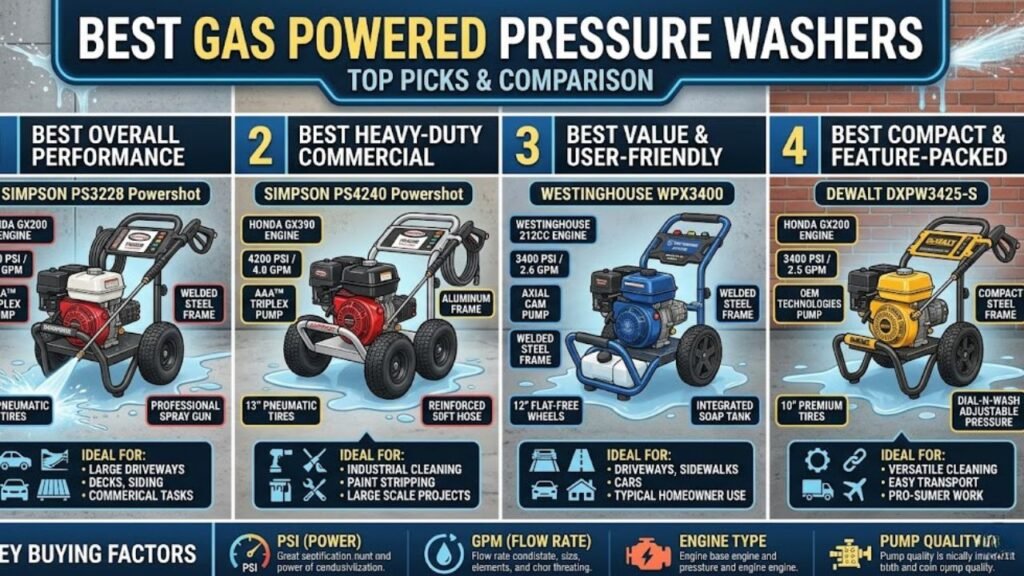
Don’t get hypnotized by PSI alone. GPM (gallons per minute) is equally important.
- PSI determines how hard the water hits — critical for stripping grime.
- GPM determines how fast you rinse — critical for efficiency.
- Cleaning Units (PSI × GPM) is the real performance number.
A 3,200 PSI / 2.5 GPM machine (8,000 CU) will clean a driveway faster than a 4,000 PSI / 1.5 GPM machine (6,000 CU). More PSI isn’t always more effective.
Engine Brand Matters More Than You Think
| Engine Brand | Reliability Tier | Notes |
| Honda | ⭐⭐⭐⭐⭐ | Industry benchmark. GC190 series is exceptional. |
| Briggs & Stratton | ⭐⭐⭐⭐ | Reliable, wide parts availability. |
| Subaru/Robin | ⭐⭐⭐⭐ | Less common but highly durable. |
| Generac | ⭐⭐⭐ | Solid mid-tier performer. |
| Generic OHV | ⭐⭐ | Acceptable for light, occasional use. |
Pump Type: Axial vs. Triplex
This is the most overlooked spec when buying a gas pressure washer.
Axial Cam Pumps:
- Cheaper to manufacture
- Adequate for occasional residential use (under 50 hours/year)
- Life expectancy: 500–800 hours
Triplex Pumps:
- Used in commercial machines
- Serviceable — seals and valves can be replaced
- Life expectancy: 1,500–2,000+ hours
- Found in Simpson, Pressure-Pro, and premium models
Rule of thumb: If you use your pressure washer more than once a month, invest in a triplex pump. It pays for itself within 3 years.
Frame & Build Quality
Look for:
- Steel cage frames (not plastic)
- Never-flat foam-filled tires (not standard pneumatic — they go flat)
- Low-profile design for easy loading into truck beds
- Onboard hose reel if storage convenience matters
Accessories & Nozzle Sets
A good gas pressure washer should come with at minimum:
- 0° (red): Concentrated stream for tough stains — use carefully
- 15° (yellow): Heavy-duty surface cleaning
- 25° (green): General purpose — most-used tip
- 40° (white): Gentle rinsing, car washing
- 65° (black): Soap/detergent application (low pressure)
- Turbo/rotary nozzle: Up to 50% faster cleaning on concrete (optional but highly useful)
Noise Levels & Maintenance Expectations
Gas pressure washers are loud — typically 75–85 dB, similar to a lawnmower. In urban or suburban neighborhoods, check local ordinances on noise before purchasing.
Maintenance reality check:
- Oil changes every 50 hours of operation
- Spark plug replacement annually
- Air filter cleaning every 25 hours
- Pump oil check (triplex pumps) every 100 hours
- Winterization before storage (critical to prevent pump freeze damage)
PSI Guide: Match the Machine to the Job
| Cleaning Task | Minimum PSI | Recommended PSI |
| Car/vehicle washing | 1,200 | 1,400–1,900 |
| Patio furniture & BBQ grill | 1,500 | 1,500–2,000 |
| Wood deck & fence | 1,500 | 1,500–2,200 |
| Vinyl siding | 1,300 | 1,300–1,600 |
| Concrete driveway | 2,500 | 3,000–3,500 |
| Brick & paver cleaning | 2,000 | 2,500–3,200 |
| Paint stripping | 2,500 | 3,000–4,000 |
| Graffiti removal | 3,000 | 3,500–4,000 |
| Farm equipment | 2,500 | 3,000–3,500 |
Caution: Using 3,000+ PSI on wood, painted surfaces, or vehicles can cause irreversible damage. Always test on an inconspicuous area first.
Safety Tips Before You Start
Gas pressure washers are powerful tools. Treat them with respect.
- Never point the nozzle at people, pets, or yourself. High-pressure water causes serious injuries. [(Insert source: Consumer Product Safety Commission injury data)]
- Wear closed-toe shoes. Sandals offer zero protection from a pressurized stream.
- Use eye protection — debris gets airborne fast.
- Keep 0° nozzles away from soft surfaces. They will cut wood, damage paint, and etch concrete if held too close.
- Maintain minimum 6–12 inch standoff distance depending on PSI and surface type.
- Never run the engine in an enclosed space. Carbon monoxide poisoning is a real risk.
- Engage the trigger safety when moving between surfaces.
Gas Pressure Washer Maintenance Checklist
After Every Use
- Release pressure by squeezing the trigger after shutting off
- Flush the pump with clean water (30 seconds)
- Disconnect and drain hoses
- Wipe down the engine and frame
- Inspect nozzles for clogs or damage
- Check for oil leaks
Seasonal Storage Tips
- Change the engine oil before long storage
- Add fuel stabilizer to the gas tank
- Run the engine for 2 minutes to circulate the stabilizer
- Use pump saver/antifreeze in the pump (prevents cracking)
- Store in a dry, frost-free location
- Remove the spark plug and add a few drops of oil to the cylinder before storage
Skipping winterization is the #1 reason gas pressure washers fail prematurely. A cracked pump costs $100–$300 to replace. Pump saver costs $8.
Frequently Asked Questions
Q1. What PSI gas pressure washer do I need for home use?
For most homeowners, 2,800–3,200 PSI with 2.0–2.5 GPM is the sweet spot. This range handles driveways, siding, decks, and vehicle cleaning without risking surface damage. You rarely need more than 3,500 PSI for residential tasks.
Q2. Are gas pressure washers worth the investment?
Yes — for heavy or frequent use. If you’re cleaning more than 2–3 times per year, or tackling concrete, siding, and large decks, gas delivers cleaning power that electric units simply can’t match. For occasional light cleaning, a $150 electric unit may serve you better.
Q3. How long do gas pressure washers last?
With proper maintenance:
- Axial pump machines: 500–800 operational hours (4–8 years for average homeowners)
- Triplex pump machines: 1,500–2,000+ hours (10–15 years with maintenance)
- Honda engines: Known to run 20+ years with basic upkeep [(Insert source: Honda GC engine service data)]
Q4. Can I use a gas pressure washer on my car?
Yes, but with caution. Use only the 40° white nozzle or a foam cannon at low pressure. Maintain at least 12–18 inches of distance. Never use a 0° or 15° nozzle on paint, rubber, or glass. Some detailers recommend using an electric washer for vehicle washing specifically, as gas washers offer less pressure control.
Q5. What is better: 2.5 GPM or 3.0 GPM?
3.0 GPM is better for large surfaces. Higher GPM means more water flow, which rinses dirt faster. For cleaning concrete driveways over 500 sq ft, 3.0 GPM noticeably reduces total job time. For smaller residential tasks, 2.5 GPM is perfectly adequate and consumes less water.
Q6. Best gas powered pressure washer under $300?
The Westinghouse WPX3200 is our top recommendation in this price range. It delivers 3,200 PSI / 2.5 GPM (8,000 CU) at roughly $280–$320 USD, making it the best value gas pressure washer currently available.
Q7. Is a Honda engine pressure washer worth the price premium?
Absolutely, for long-term ownership. Honda GC-series engines are engineered for reliability and have a global service network for parts. If you plan to keep your pressure washer for 7+ years, a Honda-equipped model pays for itself in avoided repair costs.
Final Verdict: Which Gas Pressure Washer Should You Buy?
Here’s the bottom line:
- Best overall: Simpson MSH3125-S — Honda engine + triplex pump = unmatched long-term value
- Best for most homeowners: Westinghouse WPX3200 — 8,000 cleaning units at a budget-friendly price
- Best heavy-duty: Simpson MegaShot MS60763 — highest GPM, built for professionals
- Best for first-time buyers: Ryobi RY803001 — lightest, simplest, affordable
No single machine is right for every user. Match your machine to your actual cleaning frequency, surface types, and budget — not to the highest PSI number on the shelf.